When Tigers Need Vigara
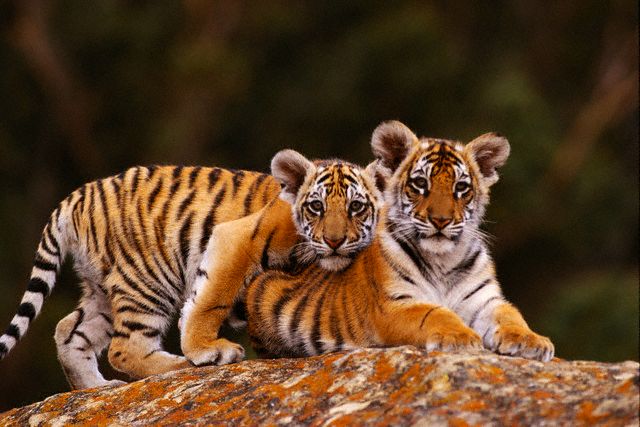
Saving the Chinese tiger may depend on viagra.
The reason: after wiping out all their habitat, and shooting and trapping them into what is very likely extinction in the wild, the only Chinese tigers left are in 10 Chinese zoos where years of captivity have wiped out
their sexual desire.
Vigara may be the cure.
What happened to the Chinese tiger?
As late as the 1950s there may have been as many as 4,000 tigers left in China. Using such slogans as "Man Must Conquer Nature," however, Mao Zedong led a campaign that leveled forests and lauded villagers for killing them with traps, poisons and crossbows.
One of the impetus' behind China's land clearing was the need to put more land under the plow in order to feed China's burgeoning human population, then at just over 562 million.
Today China's population is over 1.27 billion and is projected to top 1.4 billion by 2025.
Is there any good news here?
Believe it or not, there is.
Thanks to improved government economic policies, a rapid decline in birth rates, and rapid increases in agricultural production, the government of China is now planning to convert 16 million acres of cultivated farm land back to forests -- a total area of 25,000 square miles.
In addition, the Chinese government has created a Chinese tiger studbook in order to make sure genetic variation is preserved and inbreeding reduced.
This last-gasp effort to save the Chinese tiger is at a perilous point: there are only 56 Chinese tigers left, and perhaps half are thought to be too old to reproduce. Each of these captive tigers descends from a tiny
gene pool established through only six wild-caught tigers. The tigers now in captivity in China's zoos are all third and fourth generation descendents of these original six wild-caught tigers.
The immediate goal of China's tiger breeding program is to raise the number of captive tigers to 120 breeding tigers established from thirty founders. When 120 tigers are in hand, scientists believe they will have the genetic
diversity they need to sustain the Chinese tiger indefinitely.
The Chinese are confident their tiger breeding initiative will be successful, and are already planning to send select Chinese tiger cubs to South Africa in order to habilitate them to hunting on their own (South Africa has some experience transitioning large cats back into the wild).
Once a handful of Chinese tigers are able to hunt on their own, they will be returned to China and released into the new tiger reserves -- hopefully to coincide with the 2008 Beijing Olympics, for which the tiger will be a
mascot.
posted by PBurns @ 7:33 AM


<< Home