National Security and Population Growth
 .
.
Just nine months before the September 11th bombing of the World Trade Center, the Central Intelligence Agency warned that population growth in the Middle East and the developing world was sowing the seeds of unrest in the Middle East.
As the CIA report, entitled Global Trends 2015, notes:
"A key driver for the Middle East over the next 15 years will be demographic pressures, specifically how to provide jobs, housing, public services, and subsidies for rapidly growing and increasingly urban populations.
By 2015, in much of the Middle East populations will be significantly larger, poorer, more urban, and more disillusioned. In nearly all Middle Eastern countries, more than half the population is now under 20 years of age. These populations will continue to have very large youth cohorts through 2015, with the labor force growing at an average rate of 3.1 percent per year.
The problem of job placement is compounded by weak educational systems producing a generation lacking the technical and problem-solving skills required for economic growth . . . Rather than conventional war, the region is likely to experience more terrorism, insurgencies, and humanitarian emergencies arising from internal disparities or disputes over ethnic or religious identity."
To read the full report, >> click here
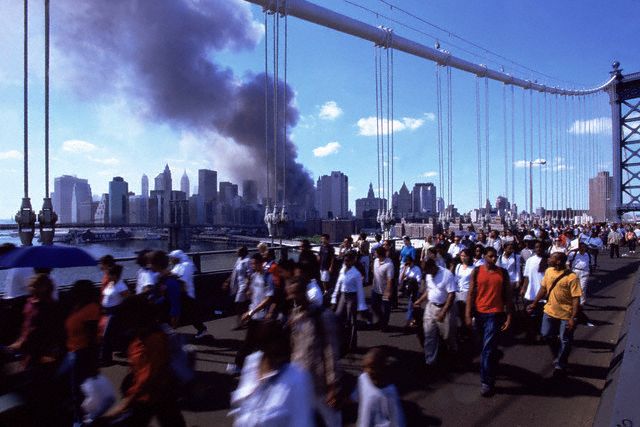
After September 11th, the American public began wondering what might transpire next, and a giant game of "What If" was played at the national water cooler. What if poison were released in the subways? What if the San Francisco Bay Bridge were blown up? What if the Lincoln Tunnel were bombed? What if an airplane crashed into the Super Bowl?
One obvious terrorist target, on nearly everyone's short list, were the many nuclear reactors scattered across the country, especially those located near our large urban centers.
Of course these are well protected, right? Maybe not.
After the attack on the American Marine Corps Barracks in Beirut in 1991, the Nuclear Regulatory Commission began thinking a little more about sabotage and a program of nuclear power plant safety drills known as "Operational Safeguards Response Evaluation" (OSRE) was initiated.
In these safety drills, four off-duty security guards were hired to conduct a mock attack on a nuclear power plant. For obvious reasons, these nuclear plants were warned that the fake attacks were going to occur, yet at nearly half of the plants tested (about 80 were tested in all) the attackers were able to destroy at least one of their "target sets."
In short, the most straight-up kind of terrorist assault on a nuclear power plant might work. As for what might happen if a large, fuel-loaded airplane were crashed into a nuclear reactor containment shell, that's anybody's guess. And, of course, a terrorist might not be the cause of any problem that might occur.
In 1987, NRC inspectors arrived at the Peach Bottom Unit 3 reactor near Lancaster, Pennsylvania and found the control room crew fast asleep.
All of this is preamble to the fact that with a nuclear power plant you have to prepare for the worst. Contrary to popular opinion, the worst is not a nuclear explosion (it can't happen with a reactor), but a steam explosion or (more likely) a massive release of radioactive steam to avoid such an explosion. Obviously, in such a situation, the first order of business would be to evacuate the people living "downwind" from the plant.
Or at least that's the theory.
In practice, population densities around many nuclear power plants are so high that evacuation of the downwind population may be difficult if not impossible.
A good example of the problem can be seen with the Indian Point nuclear power plant outside of New York City. This is the nuclear power plant the World Trade Center bombers flew over on their way to their final destination.New York Governor George Pataki asked James Lee Witt, the former head of FEMA, to evaluate the Indian Point evacuation plan. The report was released in January of this year, and what it found was that there are too many people and too few roads to make an evacuation possible without a significant portion of the downwind population being subject to "an unacceptable dose of radiation."
In short, at both ends of the globe, from the launching of a terrorist cell to the inability of our own population to get out of harm's way, we may find that the words "population bomb" come closer to being descriptive than we once imagined. And, of course, if a plane crashes into a nuclear power plant and the roads are so packed no one can flee, no one will ever connect the problems with the failure to address population growth at home or abroad.
posted by PBurns @ 11:46 AM


<< Home