Koalas on the Pill
 .
.
With wild game it's always interesting to look at population numbers and the competing story threads that often surround them.
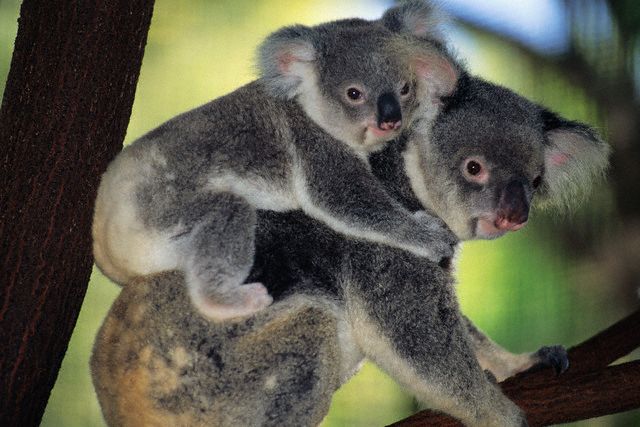
Take Koalas.
Today's story is that there are so many Koala's in parts of Australia that they are giving them long-lasting contraceptive implants to restrain the growth in their numbers.
Meanwhile, just a week ago, Steve "Crocodile Hunter" Irwin was arguing that Koalas should be extended protection as an endangered species in Australia.
In fact, both points of view can be correct, depending on location, habitat, and what population thresholds you are trying to achieve (pre-settlement, large and stable, mere species survival, etc.).
Koalas were pushed nearly into extinction by overhunting at the turn of the Twentieth Century, but their numbers have clearly rebounded a lot -- a very good thing. On the other hand, the eucalyptus forests upon which they depend for food are increasingly fragmented due to housing sprawl and wild fires, and the result is that Koalas (an almost entirely arboreal species) often find they have to hit the ground to get to new patches of food, which puts them in danger of increased predation by dogs and dingoes.
Koalas Going on the Pill
CANBERRA - Female koalas are being given contraception in the Australian state of Victoria because the population is eating itself out of house and home.
Parks Victoria is planning to inject a small tube containing the same hormones as the contraceptive pill under the skin of around 3,000 wild female koalas in the Mount Eccles National Park, 300 km (186 miles) southwest of Melbourne.
Sally Troy, Parks Victoria's research manager, said today that the koala population had to be brought under control because their staple food, the manna gum in the Mount Eccles National Park, was close to depletion.
"The forest is continuing to decline as the animals just keep eating and breeding," Troy told Reuters.
"We're concerned there is a really high risk that we will get a population crash in the next five years - that is the trees die and thousands of koalas starve to death," Troy said. "We have found that relocation and surgical sterilization hasn't worked that well, so now we're shifting to a more humane, large scale option which is basically putting them on the pill."
Troy said contraceptive implants, which can be inserted on-the-spot without the use of any anaesthetic and last for about five years, have previously been used in zoos on kangaroos and other marsupials, but never on wild animals. Koalas can live for up to 18 years and may produce between eight and 11 offspring during their lifetime. They generally start breeding when they
are around two-years-old.
The Australian Koala Foundation says there are around 100,000 of the creatures in the country. "There's not a lot of predator pressure on these animals anymore ... They are also protected species so the numbers in some areas have just grown steadily," Troy said. She said the Parks
Victoria operation to catch and inject the contraception tubes into the koalas would begin late next year and was likely to take two years.
posted by PBurns @ 8:24 AM


<< Home